
Greek Culture and Traditions
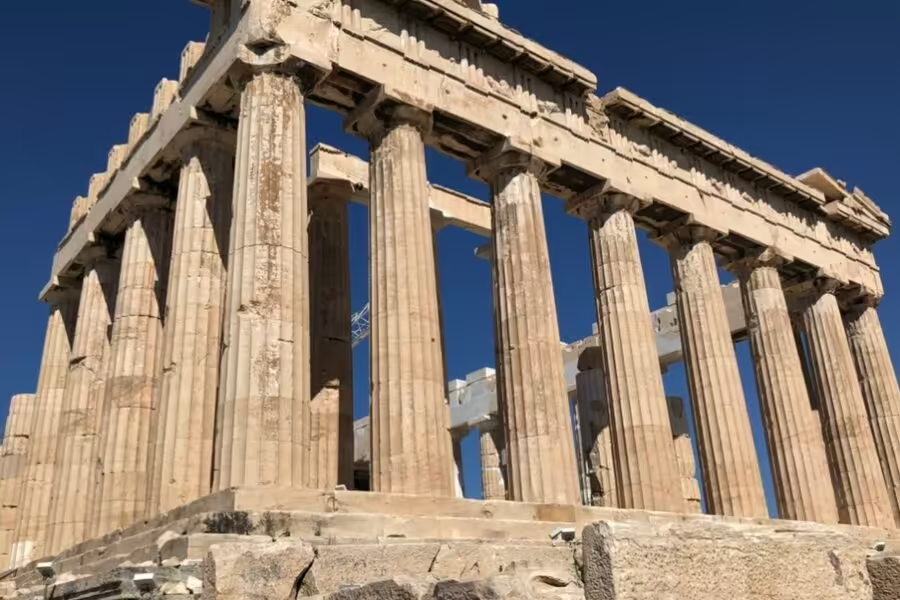
Hellenic Cultural Foundation
Alongside St. Demetrios and the Tucson Greek Festival, the Hellenic Cultural Foundation helps sustain Greek culture in Tucson through education and community outreach. The foundation supports Greek language and Hellenic studies, offers scholarships through the University of Arizona, and hosts cultural and educational events that connect Tucson to the wider traditions of the Greek world.
The Hellenic Cultural Foundation is a Tucson-based nonprofit focused on preserving and promoting Greek language, history, literature, archaeology, and culture in Tucson and Southern Arizona. According to the foundation, it supports both ancient and modern Greek studies, hosts lectures and cultural events, funds scholarships for University of Arizona students, and supports archaeological field projects in Greece.
The University of Arizona also describes the Hellenic Cultural Foundation as an independent organization of Tucson’s Greek community that helped found the university’s Modern Greek Studies Program in 1984. The university says the foundation promotes excellence in Greek language and culture by offering annual scholarships to students studying areas such as modern Greek, ancient Greek, literature, philosophy, archaeology, anthropology, and ancient history.
Greek History in Tucson
Greek culture in Tucson has deep roots that reach back to the late nineteenth century, when early Greek immigrants became part of the city’s growing and diverse population. Over time, what began as a small immigrant presence developed into a lasting community shaped by faith, family, entrepreneurship, and cultural tradition. While the earliest years are not always documented in one simple public timeline, scholars have traced Greek settlement in Tucson to the late 1800s, showing that the Greek presence here began decades before a formal parish was established.
A major turning point came in 1947, when Tucson’s Greek Orthodox community purchased the former First Christian Church on Second Avenue. According to St. Demetrios’ parish history, Gus Papadeas and Chris Boukidis made the initial deposit, and the local AHEPA chapter helped organize the effort to secure the property. The parish says the church was named in memory of Demosthenes (Demetrios) Petropoulos and Demetrios Panas, two AHEPANs who were killed in action during World War II. That moment gave Tucson’s Greek community a permanent spiritual and cultural home and helped establish Greek Orthodoxy as a visible part of the city’s life.
As the community grew, so did its institutions. In 1951, St. Demetrios received its first permanent priest, and in 1955 land was purchased on Fort Lowell Road for a new church. The new sanctuary was dedicated in December 1968, becoming a center of worship, fellowship, and Greek community life in Southern Arizona for generations. Parish archive materials preserve this history through photographs and milestones from the Second Avenue years to the Fort Lowell church and, later, to the move to the parish’s current site on North Alvernon Way in 2022.
One of the most visible expressions of Greek culture in Tucson has been the Tucson Greek Festival. The festival grew into one of the city’s best-known cultural celebrations, opening Greek food, music, dancing, hospitality, and church life to the wider public. Local reporting says the festival had been running at St. Demetrios for about 41 years by 2017, and more recent coverage says it was a tradition at the church site since 1976. That makes the festival one of the clearest examples of how Tucson’s Greek community shared its heritage with the broader city.
Greek culture in Tucson is also notable for its connection to education and scholarship. The Hellenic Cultural Foundation, an independent organization of Tucson’s Greek community, helped found the Modern Greek Studies Program at the University of Arizona in 1984 and has supported student scholarships in Greek language and culture. That gives Tucson a distinctive cultural story: Greek life here has been expressed not only through church and festival traditions, but also through academic study, cultural preservation, and public learning.
Taken together, these institutions tell the story of Greek Tucson as a community rooted in both tradition and contribution. From early immigrants in the late 1800s, to the founding of St. Demetrios in 1947, to the long-running Greek Festival and support for Hellenic studies at the University of Arizona, Greek culture in Tucson has been shaped by worship, hospitality, education, and a strong sense of community.